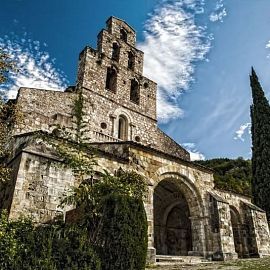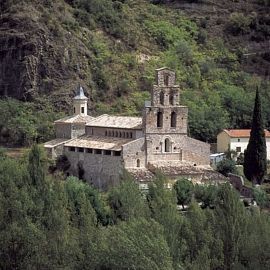


MONASTERY OF SANTA MARIA
Some historians place the origins of Gerri in Roman times, when the salt flats began to be exploited. However, the first documentary references confirming the existence of a salt production operation date from the 9th century, when the priest Espanell founded the Gerri monastery on June 20, 807, originally dedicated to Saint Vincent. Over time, thanks to donations and acquisitions, it became one of the main landowners in the area. In fact, several authors link the location of the Gerri monastery to the presence of the saltwater spring.
The current building of Santa Maria, consecrated on September 25, 1149, was built following the typical layout of early medieval monasteries, although the original building was located in a small Visigothic church near the present site, as documented archaeologically. It was one of the wealthiest monasteries in the Diocese of Urgell, its extensive holdings being notable for its salt and saltworks, a key resource in the medieval period.
During the Modern Age, the abbots of the Santa Maria monastery continued to own their saltworks. With the decline of the monastery and the confiscations of church property in the first half of the 19th century, the loss of their territorial control also affected these holdings. The history of the monastery culminated in the secularization of 1835, which led to the dispersal of the community and the loss of its assets. Since 1970, Gerri de la Sal and the Santa Maria de Gerri monastery have been declared a picturesque site, and it wasn't until 1995 that the application for reclassification as a Cultural Asset of National Interest was submitted, with the categories of historical site and historical monument, respectively.
How to get there: via the N-260, just in front of the village of Gerri (free public parking).
Address: 25560 Gerri de la Sal (Baix Pallars)
Telephone: +34 677 70 18 20